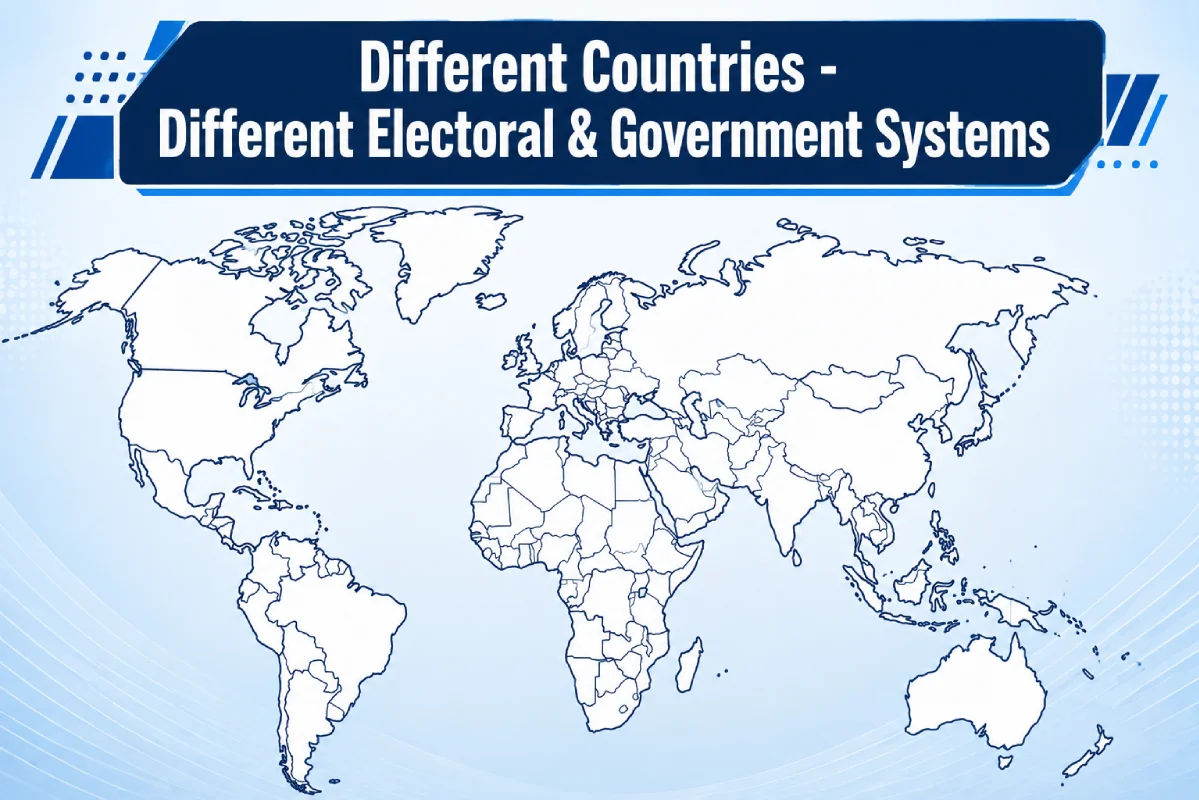
Every nation answers the same basic question — who gets to rule, and how — in strikingly different ways. Some hand that choice directly to citizens. Others filter it through layers of representatives, parties, or bloodlines. This piece looks at ten of the world’s most closely watched nations — India, the USA, Russia, the UK, France, Germany, Australia, China, Japan, and Saudi Arabia — to understand how each forms its government, before zooming out to see where the world stands as a whole.
1. Understanding the Terms
Before comparing countries, it helps to define the systems they run on. A democratic election is a process where eligible citizens choose their representatives or leaders through a vote, typically held at regular intervals, with multiple parties or candidates competing. Elections can be direct (citizens vote for the leader themselves, as in a presidential election) or indirect (citizens vote for representatives, who then choose the leader — as with a Prime Minister chosen by Parliament). A parliamentary system is one where the head of government (usually a Prime Minister) is drawn from and accountable to the elected legislature, while a presidential system has a head of government directly elected by citizens and serving independently of the legislature for a fixed term. A semi-presidential system blends both — a directly elected President who shares power with a Prime Minister answerable to parliament. A constitutional monarchy is a system where a hereditary monarch serves as ceremonial head of state while real governing power rests with an elected parliament and government; an absolute monarchy, by contrast, gives the monarch full, largely unchecked authority over the state. Finally, a one-party (communist/socialist) state is a system where a single party — such as the Communist Party — controls the government, and while elections may exist at various levels, genuine multi-party competition for national leadership is absent.
2. How Each Nation Chooses Its Government
| Country | System Type | Head of State (August 2026) | Head of Government (August 2026) | How the Top Leader Is Chosen |
|---|---|---|---|---|
| India | Parliamentary republic | President (Droupadi Murmu) | Prime Minister (Narendra Modi) | Citizens directly elect Members of Parliament (Lok Sabha) every 5 years; the majority party/coalition’s leader becomes PM. The President is chosen indirectly by an electoral college of MPs and state legislators. |
| USA | Presidential republic | President (Donald Trump) | President (same person) | Citizens vote in a presidential election every 4 years, but the President is formally elected by the Electoral College, based on state-wise results. |
| Russia | Semi-presidential federation | President (Vladimir Putin) | Prime Minister (appointed) | The President is directly elected by popular vote (currently a 6-year term) and appoints the Prime Minister, who needs approval from the State Duma (parliament). |
| United Kingdom | Parliamentary constitutional monarchy | Monarch (King Charles III) | Prime Minister (Andy Burnham) | The monarchy is hereditary. Citizens elect Members of Parliament (House of Commons) in a general election; the leader of the party commanding a majority becomes PM — sometimes without a fresh public vote if a change happens mid-term. |
| France | Semi-presidential republic | President (Emmanuel Macron) | Prime Minister (appointed) | The President is directly elected by citizens via a two-round popular vote every 5 years and appoints the Prime Minister, typically from the majority party in the National Assembly. |
| Germany | Parliamentary federal republic | President (largely ceremonial) | Chancellor (Friedrich Merz) | Citizens elect the Bundestag (parliament); the Chancellor — the real head of government — is then elected by the Bundestag, usually the leader of the largest coalition. |
| Australia | Parliamentary constitutional monarchy | Monarch (King Charles III, via Governor-General) | Prime Minister (Anthony Albanese) | Citizens elect the House of Representatives; the leader of the majority party becomes PM, formally appointed by the Governor-General. |
| China | One-party socialist state | President (Xi Jinping) | Premier (State Council head) | No direct national elections for top leadership. The National People’s Congress — chosen through multiple indirect tiers, with candidates vetted by the Communist Party — formally elects the President; real power rests with the Party’s General Secretary. |
| Japan | Parliamentary constitutional monarchy | Emperor (Naruhito, ceremonial) | Prime Minister (Sanae Takaichi) | Citizens elect the National Diet (parliament); the majority coalition’s leader is then elected Prime Minister by the Diet. |
| Saudi Arabia | Absolute hereditary monarchy | King (Salman bin Abdulaziz Al Saud) | King (same person) | There are no national elections for the head of state. Succession follows the royal family, currently guided by King Salman and Crown Prince Mohammed bin Salman, who holds day-to-day governing authority. |
3. Where the World Stands, Overall
Zooming out, the global picture is a genuine mix of systems. Of the 167 countries and territories tracked by the Economist Intelligence Unit’s Democracy Index (2025), roughly 80 qualify as full or flawed democracies, while the remaining 87 are classified as hybrid or authoritarian regimes — meaning slightly under half the world’s nations run genuinely competitive, multi-party electoral systems, and just over half operate with varying degrees of restricted political competition. Monarchies, meanwhile, remain more common than many assume: 43 sovereign states still have a king, queen, emperor, sultan, or similar hereditary head of state — 13 in Asia, 12 in Europe, 9 in the Americas (mostly Commonwealth realms), 6 in Oceania, and 3 in Africa — though the large majority of these are constitutional monarchies where day-to-day power sits with an elected government, not the throne. A smaller group of nations, including China, Vietnam, Laos, and Cuba, remain single-party states where the ruling party controls candidate selection and leadership succession outright. Taken together, the world’s approach to choosing leadership spans a wide spectrum — from direct citizen votes for a head of state, to layered parliamentary elections, to hereditary succession, to single-party control — each shaping, in very different ways, how accountable a government ultimately is to the people it governs.
— Vote Mantra | Professionally Political